
Reviewed · TEMPLE TOURS
Chiang Mai Temples and Market Tuk-Tuk Evening Night Tour
Chiang Mai glows after sunset. This four-hour tuk-tuk outing is a lively way to see several old-city temples, learn about Buddhism and local culture, and finish with food at the Night Bazaar. I especially like the cooler evening timing and the simple street-food meal, though the experience depends heavily on your guide’s English and the weather.
I also like the small-group limit of 12 people and the easy one-way route through Chiang Mai. You ride between sights instead of arranging several short taxi trips, and a guide can help you make sense of unfamiliar dishes at the market. The main catch is that two temple admission fees cost extra, and a few past outings have been shorter than the advertised four hours.
In This Review
- Key points before you book
- Why an evening tuk-tuk works well in Chiang Mai
- Meeting at Thapae and understanding the route
- Wat Phra Singh: a strong first temple
- Wat Phan Tao: a short look at an older temple
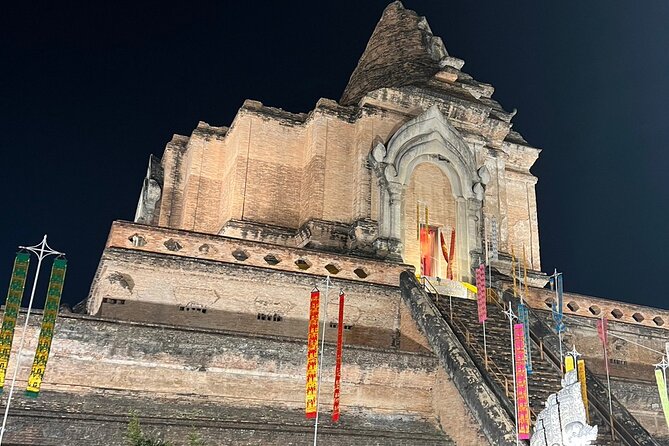
- Wat Chedi Luang and its great stupa
- Wat Lok Molee outside the old walls
- The Night Bazaar: food, dessert, and free time
- What the $34.24 price really covers
- The guide can make or break the evening
- Group size, timing, rain, and comfort
- Who should book this tour?
- FAQ
- What time does the tour start?
- Where is the meeting point?
- Where does the tour finish?
- How long does the tour last?
- Are temple entrance fees included?
- Is food included?
- What happens if it rains?
- Should you book the Chiang Mai temple tuk-tuk tour?
Key points before you book
- Temples look different at night: Wat Phra Singh, Wat Phan Tao, Wat Chedi Luang, and Wat Lok Molee take on a quieter, more atmospheric look after dark.
- The tuk-tuk is the transport and part of the fun: Open-air rides offer a breeze between stops, but rain and vehicle condition can affect comfort.
- Food is included: You receive a simple street-food meal, dessert, and bottled water, while drinks and personal purchases cost extra.
- Two entrance fees are separate: Bring cash for THB 50 at Wat Phra Singh and THB 50 at Wat Chedi Luang.
- The Night Bazaar is the finale: You have about 90 minutes for food and browsing at Chiang Mai’s best-known evening market.
- Guide quality matters: Guides such as Tik, Jane, Nancy, Saman, Maa, Mali, and Molly have been praised for clear stories and warm service, but English ability has not been consistent for every group.
Why an evening tuk-tuk works well in Chiang Mai
Chiang Mai’s old city is compact, but the temples are spread across several streets. You can walk between some of them, yet doing four stops in one evening takes time, especially in heat or rain. The tuk-tuk gives you a practical link between each sight while also showing you the city at street level.
The 6:30 pm start is well chosen. You may catch the last soft light of dusk at the first temple, then see the buildings lit against the dark sky. The air is usually more comfortable than during a midday temple visit, and the courtyards can feel calmer after the hottest part of the day.
The ride itself is not luxury transport. A tuk-tuk has a low roof, open sides, and firm seating. That is exactly why many people enjoy it, but it can be awkward for anyone who finds high steps, limited legroom, or road noise difficult. One poor experience involved a tuk-tuk with no useful rain protection and a missing step, so it is sensible to ask the guide for help getting in and out if needed.
You should also expect traffic noise and the occasional shower. The tour operates in rain or shine. During the rainy season, bring a poncho or light raincoat rather than relying only on an umbrella.
More Market Tours in Chiang Mai
- Chiang Mai: Cooking Class, Market & Thai Herbs Garden Tour
★ 4.9 · 4,824 reviews - Chiang Mai: Authentic Cooking Class with Market & Farm Visit
★ 4.9 · 4,546 reviews - Chiang Mai: Cooking Class with Market and Pickup
★ 4.9 · 1,365 reviews
Meeting at Thapae and understanding the route
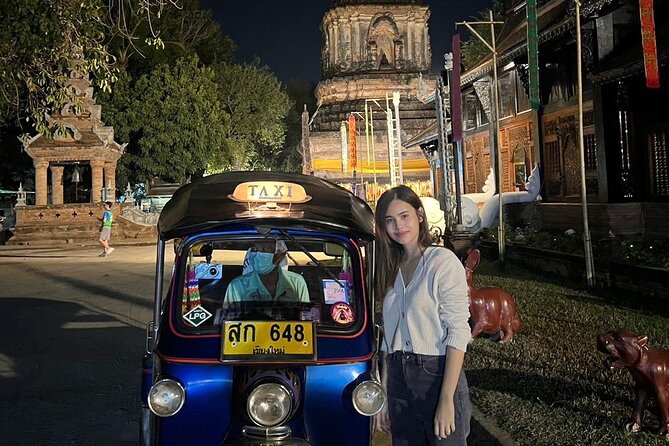
The meeting point is Burger King at Thapae2-6 Rachadamnoen Road, in the old city area. The tour begins at 6:30 pm, and the operator allows a maximum of 10 minutes after the scheduled start before the group moves on.
This is not a hotel pickup tour. You need to reach the starting point yourself, and the tour ends at Chiang Mai Night Bazaar on Changklan Road. That one-way design is efficient, but it matters when planning your evening. If your hotel is in the old city, the start may be an easy walk, while the finish could require a separate ride back.
I recommend arriving early, finding the exact meeting point, and carrying only what you need. The tour ends in a busy market area, so keeping your phone, wallet, and any purchases secure is wise. A mobile ticket is provided, and booking confirmation arrives at the time of booking.
Wat Phra Singh: a strong first temple
Wat Phra Singh is one of the most famous temples inside Chiang Mai’s old city walls. Its name is often translated as the Monastery of the Lion Buddha, and it remains an active place of worship rather than a silent monument.
You have about 30 minutes here. That is enough for an introduction to the grounds, key buildings, and Buddhist practices, but not enough for a slow inspection of every detail. A good guide can help you focus on the temple’s visual features and explain why the site matters instead of leaving you to take photographs without context.
This is one of the paid stops. Admission is THB 50 per person and is not included in the tour price. Keep cash ready, since the tour information says the fee must be paid on the day.
At night, the temple’s appearance changes. Artificial lighting draws attention to roofs, carvings, and bright details that can be hard to appreciate under strong midday sun. You should dress respectfully, covering shoulders and knees where required, and remember that this is still an active religious site.
Wat Phan Tao: a short look at an older temple
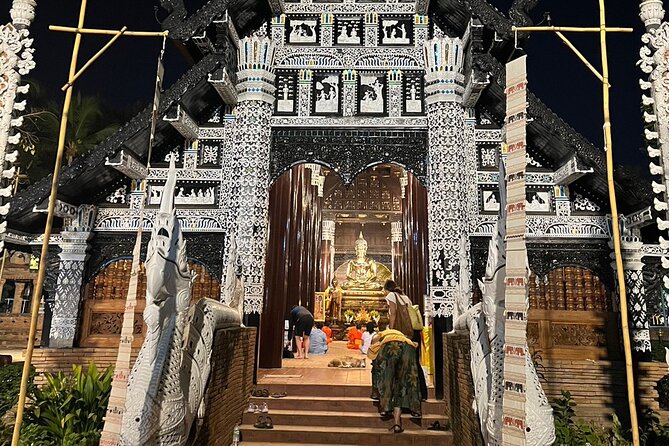
Wat Phan Tao sits next to Wat Chedi Luang and is described as one of Chiang Mai’s oldest temples. Its first structures likely date to the late 14th century, giving it an important place in the old city’s story.
The stop lasts about 30 minutes and has no admission charge. Its location beside the next temple makes it an easy pairing, though the quick pace may leave you wishing for more time if you enjoy architecture and woodwork.
This is where guide quality can make a large difference. A strong explanation about building methods, temple age, sculptures, and local religious practice turns a short stop into a useful lesson. Saman was praised for explaining construction and symbolic details, while Tik was singled out for making Buddhist practice easier to understand.
If your guide focuses almost entirely on Buddhism, you may get less information about modern Chiang Mai or the wider city. That is a fair limitation to keep in mind. This tour is primarily a temple and food experience, not a broad city-history tour.
More Temple Tours in Chiang Mai
- Chiang Mai: Chiang Rai Temples, Karen Tribe and Hot Springs
★ 4.7 · 5,401 reviews - Chiang Rai White Temple and Blue Temple Day Tour
★ 4.6 · 3,366 reviews - Chiang Mai: White, Red/Black & Blue Temples Tour with Lunch
★ 4.2 · 2,017 reviews - Chiang Mai: Doi Suthep and Wat Umong Enchanting Evening Tour
★ 4.6 · 1,811 reviews
Wat Chedi Luang and its great stupa
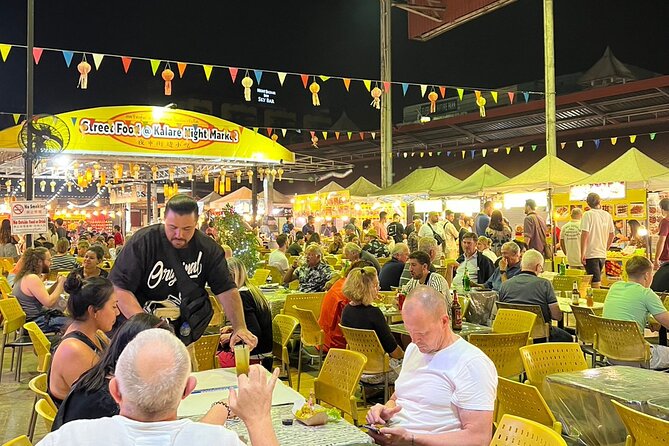
Wat Chedi Luang Varavihara is known as the Temple of the Great Stupa. Its construction took place from 1391 to 1475, and the central structure was badly damaged by an earthquake in 1545. The remaining ruin is one of Chiang Mai’s most striking historic sights.
You spend about 30 minutes here. The scale of the chedi gives this visit a different feel from the smaller temple stops. Instead of looking mainly at painted interiors or decorative details, you are confronting a huge, weathered structure that shows the force of time and nature.
Admission costs THB 50 per person, again paid separately. Together with Wat Phra Singh, the extra cost is THB 100 per person. That is not a major addition to the tour price, but it should not come as a surprise.
At this stop, listen for explanations of what the stupa once looked like, how the earthquake changed it, and what role the temple has played in Chiang Mai. The best guides use the ruin to connect architecture, religion, and the city’s past. If you only want a quick photograph, 30 minutes is plenty. If you want detailed history, the schedule may feel tight.
Wat Lok Molee outside the old walls
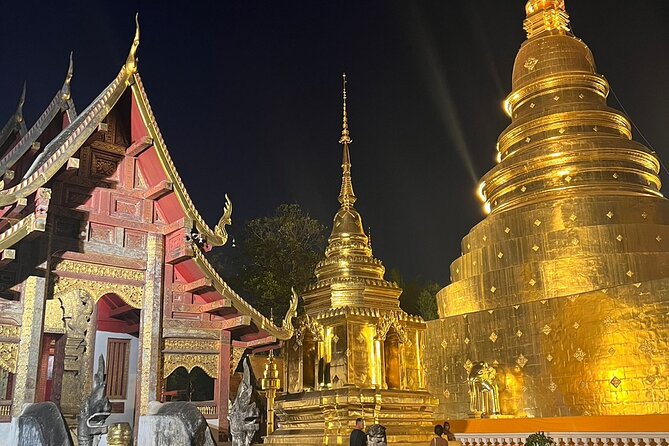
Wat Lok Molee is just outside the old walled center and is one of Chiang Mai’s older temples. The site houses one of the city’s largest and most impressive chedis, and admission is free.
This stop adds a useful change of setting. The first temples are within the old city, while Wat Lok Molee shows you a historic religious site beyond the central walls. The tuk-tuk ride also gives you a brief view of the streets between the old town’s main sights.
You again have around 30 minutes. The short visit works well for a first evening in Chiang Mai, especially if you want a broad introduction rather than an expert study of each complex. Still, the schedule can feel temple-heavy. One person found that visiting two rather than three temples might have made the evening less rushed.
That is the central choice here. If you love temples, four stops offer useful variety. If your interest is moderate, you may prefer more time at the market or a slower visit at the most important sites.
The Night Bazaar: food, dessert, and free time
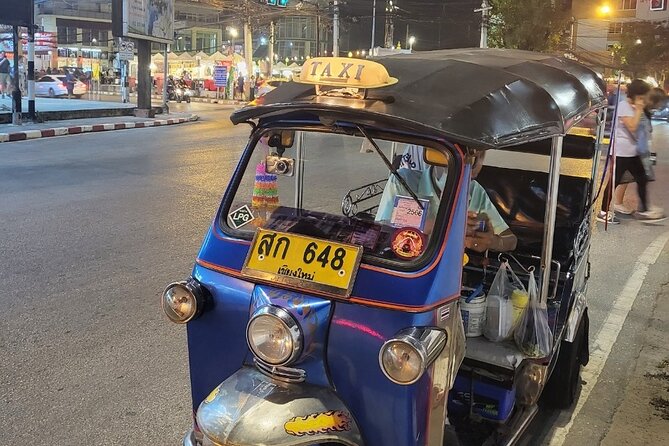
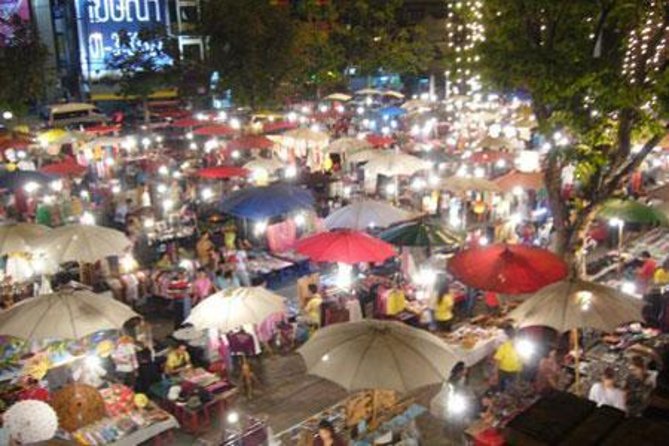
The tour ends at Chiang Mai Night Bazaar, where you have about 90 minutes. This is Chiang Mai’s best-known market area, with street-side stalls selling clothing, handicrafts, and food.
The included meal is simple rather than elaborate, but it adds real value. You receive street food, dessert, and a bottle of water. Several guides have helped people choose dishes, identify local food, and speak with vendors. That support is especially useful if you are new to Thai food or unsure how market ordering works.
One evening included khao soi, Chiang Mai’s famous noodle dish, while another group enjoyed food at a market food court. Exact dishes may vary, so do not book this expecting one fixed menu. Soft drinks and alcohol are not included, and you pay for extra snacks or shopping yourself.
The market is a good ending because you can keep exploring after the formal tour stops. You are not rushed straight back to a hotel. On the other hand, the tour does not provide a ride onward from the bazaar, so you need to arrange your own return.
The market can also feel crowded and confusing, particularly at night. A guide such as Jane has been praised for walking through the food stalls and helping with communication. That is a practical service, not just a pleasant extra.
What the $34.24 price really covers
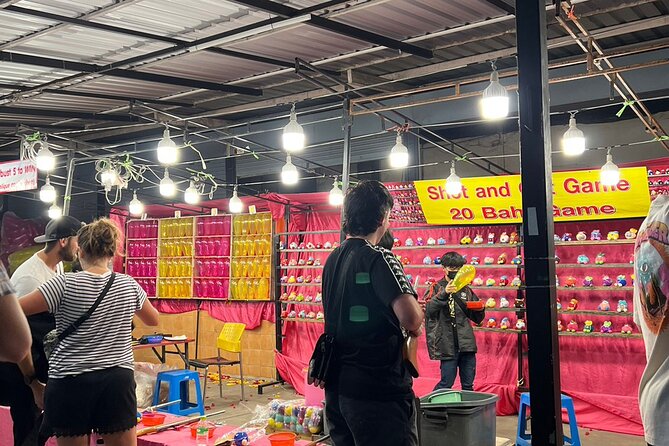
At $34.24 per person, the tour offers fair value if you want transport, a guide, four temple visits, and an included meal in one evening. You are paying for the convenience of moving around by tuk-tuk and for help making sense of places and food that could otherwise blur together.
The value is strongest for a first visit. A guide can explain Buddhist customs, temple design, sculpture details, and local history while you move through the old city. You also avoid negotiating separate tuk-tuk fares for each stop.
The value is weaker if you are already comfortable exploring Chiang Mai independently. The old city is walkable, Wat Phan Tao is free, Wat Lok Molee is free, and the Night Bazaar is easy to reach by local transport. Independent visitors can spend longer at the temples they prefer and skip the ones that interest them less.
Remember to add THB 100 per person for the two paid temples. Drinks, alcohol, shopping, and gratuities are also separate. Tips for the guide and tuk-tuk driver are optional.
The guide can make or break the evening
The strongest part of this experience is often the guide’s ability to explain rather than simply point. Tik received praise for clear lessons about Buddhist practice and the way Thai religion has blended with other traditions. Jane was praised for excellent English, city insight, photography help, and assistance at the market.
Nancy, Saman, Maa, Mali, and Molly also received warm praise for friendly service, useful temple stories, and help with food. Saman in particular was credited with explaining temple age, building techniques, sculptures, and monks in a way that kept the visit lively.
But English ability has varied. Some people found guides hard to understand and felt there was little chance to ask questions. One account also described an outing that covered only three temples and lasted about two and a half hours rather than the expected four.
I would treat the tour as a guided introduction, not a guaranteed private lecture. If your guide speaks clearly and encourages questions, the evening can be excellent. If communication is weak, the same route may feel like a string of photo stops.
Group size, timing, rain, and comfort
The maximum group size is 12 people. That is small enough for a guide to manage, though the actual group may be much smaller. One evening had only two participants, creating a near-private experience.
The four-hour schedule is approximate. The stated plan gives 30 minutes at each temple and 90 minutes at the market, with the remaining time used for tuk-tuk transfers. Delays, weather, traffic, and group pace can change the total. If you have a fixed dinner reservation afterward, leave extra time.
Rain is a real practical issue. The tour continues through normal showers and may pause under shelter during heavy rain, but cancellations caused by weather do not qualify for a refund. A poncho is more useful than an umbrella in an open tuk-tuk.
Most people can participate, and the tour is near public transportation. Still, getting in and out of a tuk-tuk may be difficult for anyone with mobility concerns. The vehicles may also have limited visibility and headroom, depending on the one assigned.
Who should book this tour?
I would choose this tour for a first evening in Chiang Mai, especially if you want to see several temples without planning every transfer. It suits people who enjoy short historical stops, street food, open-air transport, and a market finish.
It also works well for solo visitors and couples who want company and local guidance without joining a huge bus group. The small group limit keeps the experience more personal, and the night timing helps you avoid the worst daytime heat.
I would think twice if you want long, quiet temple visits, guaranteed high-level English, or a full tour of Chiang Mai’s nonreligious sights. It is also less suitable if you dislike open vehicles, have difficulty with high steps, or need a fixed end time.
FAQ
What time does the tour start?
The tour starts at 6:30 pm.
Where is the meeting point?
Meet at Burger King, Thapae2-6 Rachadamnoen Road, Tambon Si Phum, Chiang Mai.
Where does the tour finish?
The tour ends at Chiang Mai Night Bazaar on Changklan Road.
How long does the tour last?
The advertised duration is approximately four hours, though the actual length can vary.
Are temple entrance fees included?
No. Wat Phra Singh costs THB 50 per person, and Wat Chedi Luang costs THB 50 per person. Both fees must be paid in cash on the day.
Is food included?
Yes. The tour includes a simple street-food meal, dessert, and one bottle of drinking water. Soft drinks and alcoholic drinks are not included.
What happens if it rains?
The tour operates in rain or shine. In heavy rain, the guide will try to find shelter and continue when conditions improve. A raincoat or poncho is recommended during the rainy season.
Should you book the Chiang Mai temple tuk-tuk tour?
Book it if you want a cooler, guided introduction to Chiang Mai after dark, with several major temples and an easy food-market finish. The best version of the experience includes a clear English-speaking guide who explains more than Buddhism alone and helps you order at the Night Bazaar.
Before booking, budget another THB 100 for temple fees, confirm that you can manage a tuk-tuk’s steps and seating, and plan your own ride home from the market. If you prefer independence and extra time at fewer sights, walking or hiring transport yourself may suit you better. For a first night, though, this is a convenient and enjoyable way to get your bearings, see illuminated temples, and sample Chiang Mai without facing the city alone.
More Shopping Tours
- Chiang Mai: Evening Cooking Class and Local Market Visit
★ 4.9 · 648 reviews - Chiang Mai: Evening Local Street Food Market Tour
★ 4.8 · 604 reviews - Chiang Mai: Kalare Night Bazaar Boxing Stadium Muay Thai
★ 4.7 · 507 reviews - Evening Cooking Class in Organic Farm with Local Market Tour
★ 5.0 · 394 reviews
More Tuk-Tuks
- Private Chiang Mai Old City Half Day Tuk Tuk Tour
★ 4.5 · 157 reviews - Full-Day Guided Tuk Tuk Chiang Mai Adventure and Rafting
★ 5.0 · 140 reviews - Chiang Mai: Exploration of Old City by Private Tuk-Tuk
★ 4.3 · 127 reviews - Chiang Mai Temples and Market Tuk Tuk Night Tour
★ 5.0 · 95 reviews
Just added around Chiang Mai
- Chiang Mai: Chiang Rai White, Blue & Black Temples Day Tour★ 4.2 · 16 reviews
- Chiang Mai Adventure ATV Secret Waterfall and Bamboo Rafting★ 5.0 · 16 reviews
- Inthanon Small-Group with Kew Mae Pan Trail from Chiang Mai include Lunch★ 4.5 · 16 reviews
- 2-Day Best of Chiang Rai from Chiang Mai Private Package★ 4.5 · 16 reviews
- Doi Inthanon Discovery Tour: Waterfalls, Villages & Highest Peak★ 3.5 · 16 reviews
- Private-Tour Doi Suthep Temple and Khun Chang Kien Village Half-Day★ 4.5 · 16 reviews
- Chiang Mai Iconic Temples and City Tour★ 4.5 · 17 reviews
- Fantastic! Famous Doi Inthanon National park tour with 2hr trekking★ 4.5 · 17 reviews
Temple Tours, compared.
Chiang Rai Temples, Karen Tribe and Hot Springs
Read our review →
City Highlights Temple and Market Walking Tour
Read our review →
Bangkok by Night: Temples, Markets and Food Tuk-Tuk Tour
Read our review →
Grand Palace, Wat Pho, and Wat Arun Guided Tour
Read our review →
Tiger Cave Temple, Emerald Pool and Hot Springs Tour
Read our review →
Chiang Rai White Temple and Blue Temple Day Tour
Read our review →Browse the lists this tour appears in