
Reviewed · COOKING CLASSES
Chiang Mai: Evening Cooking Class and Local Market Visit
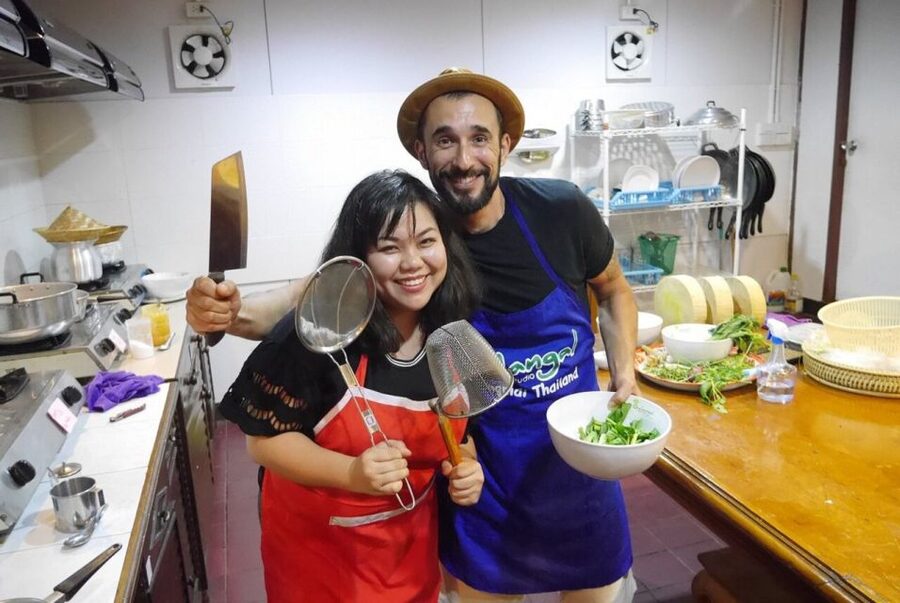
Thai food is better when you make it yourself. This five-hour evening class combines a local market visit, an organic garden stroll, and hands-on cooking at Galangal Cooking Studio. I especially like the chance to choose your own dishes and the way instructors such as New, Aoy, and Oi explain ingredients in clear, friendly English. The included hotel transfer is another strong point, especially for an evening class.
The main consideration is timing. Pickup begins around 3:15 to 3:45 p.m., and traffic can slow the journey between several hotels. The class may run until about 8:30 p.m. for a larger group, though smaller classes can finish sooner. You should also arrive hungry, because four substantial dishes make this far more than a quick demonstration.
In This Review
- Key points at a glance
- Pickup in Chiang Mai between 3:15 and 3:45 p.m.
- A market visit that explains the shopping list
- An organic garden before the kitchen
- Four dishes, four kinds of Thai cooking
- Hands-on instruction without a hard technical test
- Cool dining space and plenty of food
- Recipe choices that make the class worth repeating
- Is $28 a fair price?
- What the evening does best
- Should you book this Chiang Mai cooking class?
- FAQ
- How long does the Chiang Mai cooking class last?
- What dishes can I choose to cook?
- Is hotel pickup included?
- Can people with dietary restrictions join?
- Is the cooking school wheelchair and stroller accessible?
- What happens if I only want to watch?
Key points at a glance
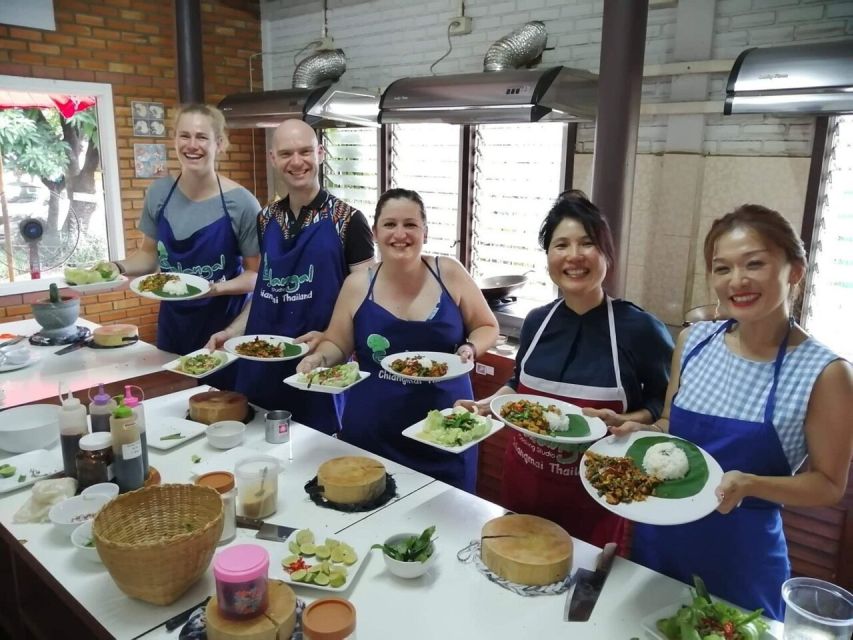
- Choose from several Thai dishes: Pick one stir-fry, soup, appetizer, and curry or curry paste.
- Start with local ingredients: Visit a market and, when arranged for the group, an organic garden.
- Cook and eat your own meal: You prepare the dishes with help, then sit down to enjoy them.
- Strong teaching: New and Aoy are often praised for patient instruction, clear explanations, and personal attention.
- Useful for special diets: Vegetarian, vegan, Halal, gluten-free, and allergy-friendly adjustments are available.
- Good value at $28: Transport, ingredients, equipment, drinks, instruction, and a recipe PDF are included.
Pickup in Chiang Mai between 3:15 and 3:45 p.m.
The evening begins with hotel pickup in central Chiang Mai. Service covers hotels in the Old City, Santitham, and parts of Huay Keaw Road between Kad Suan Kaew and Maya Shopping Mall. Some addresses around Nimmanhaemin Road, Sirimongkrajan Road, Wat Ket Road, Chang Phueak, Chang Khlan, and Chang Moi are also included, but coverage depends on the exact location.
You should wait in your hotel lobby 5 to 10 minutes before the scheduled time. The driver may arrive before 3:45 p.m., and the vehicle waits no longer than five minutes after the agreed pickup time. Evening traffic and the number of pickup stops can cause delays, so keep your afternoon free rather than planning a tight connection.
The transport is commonly a red songthaew, Chiang Mai’s familiar shared pickup truck. That makes the ride part of the local setting, though it may feel less private than a regular car. If your accommodation falls outside the pickup zone, the school will tell you where to meet the group and provide the school or market address. You can then arrange your own transport.
This service adds real value. An evening cooking class can be awkward to reach and leave, especially if you are carrying leftovers or traveling with children. Here, the return transfer is included, and transport receives particularly strong marks from the people who have taken the class.
More Cooking Classes in Chiang Mai
- Half-Day Thai Cooking Class at Organic Farm in Chiang Mai
★ 5.0 · 19,087 reviews - Chiang Mai: Cooking Class, Market & Thai Herbs Garden Tour
★ 4.9 · 4,824 reviews - Chiang Mai: Authentic Cooking Class with Market & Farm Visit
★ 4.9 · 4,546 reviews
A market visit that explains the shopping list
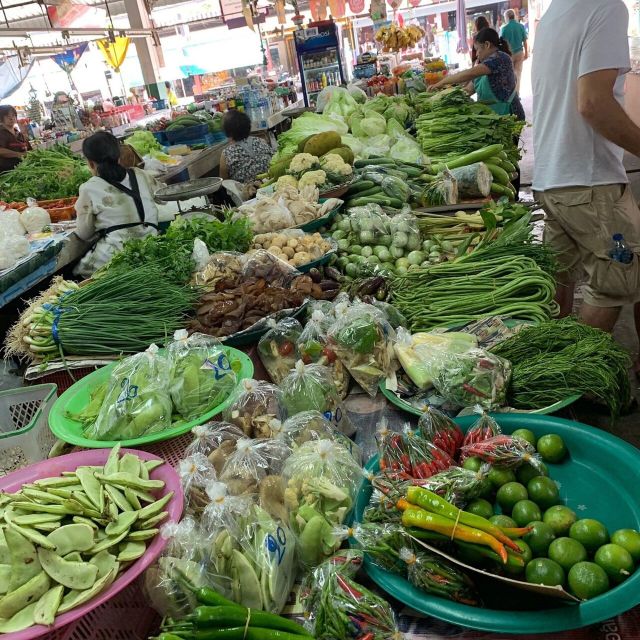
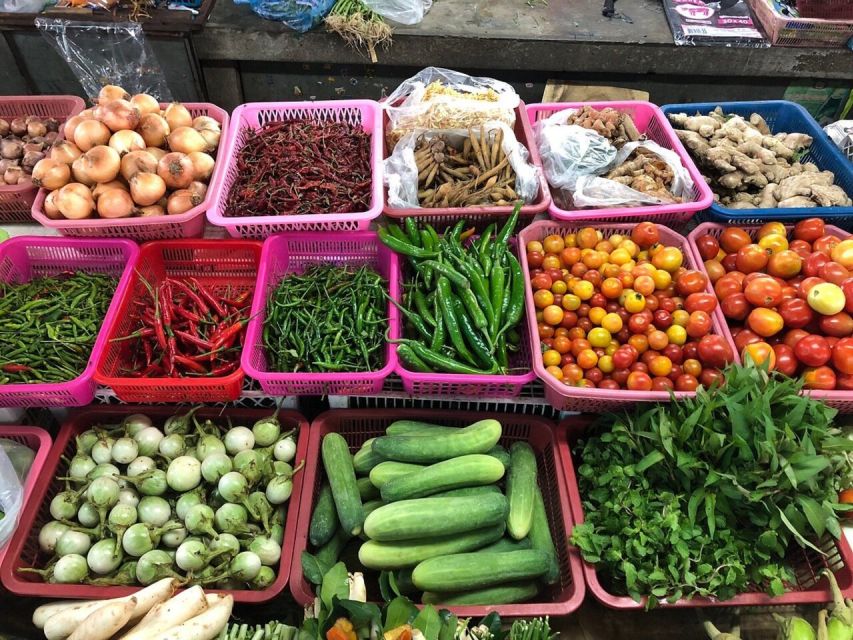
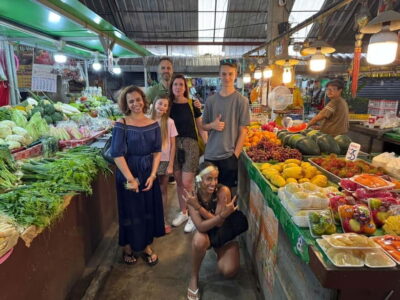
The first stop is a local market, with the exact focus depending on the group’s interests. You will see the fresh vegetables, herbs, curry ingredients, and other produce used in Thai cooking. Your instructor helps identify what you are looking at and explains why each item matters.
This short visit is not a full market tour or a long food walk. Think of it as a practical introduction to the ingredients you will soon use. That is enough to make the cooking feel less like a recipe copied from a page and more like a lesson in how Thai food is assembled.
The market also helps you understand the difference between familiar labels and actual Thai cooking. A curry paste, herb, or vegetable may look simple in a finished dish, but the market shows the raw materials before they are chopped, pounded, fried, or simmered.
You may have some time to walk around on your own. Keep expectations sensible, though. The market stop is one part of a busy five-hour program, not the main event. If you want a long independent market visit, you would need to return separately.
An organic garden before the kitchen
The itinerary also includes a visit to an organic garden. You can stroll through the growing area and see how herbs and vegetables are cultivated in Thailand. This gives useful context to ingredients that can seem mysterious when they appear only in a bowl or cooking tray.
The garden is a pleasant bridge between shopping and cooking. You have just seen ingredients at the market, and now you get a closer look at how some are grown. For a first introduction to Thai cuisine, that sequence makes sense: see the produce, learn its purpose, then cook with it.
The garden visit is not described as a large farm tour, so do not book this expecting a long agricultural excursion. Its value is in the connection it creates between Thai ingredients and the dishes on your menu.
Four dishes, four kinds of Thai cooking
At the school, you choose one dish from each category. The class covers four preparations:
- One stir-fried dish
- One soup
- One appetizer
- One curry or curry paste
The published description also refers to learning five Thai dishes, including a curry and curry paste, but the detailed menu and repeated class experiences point to four dishes prepared and eaten by each person. In practical terms, you should expect a generous four-course cooking session, with curry paste included in the curry portion when selected.
For stir-fried dishes, choices include Pad Thai, Pad See Ew, chicken with cashew nuts, and minced chicken with holy basil. This is a useful range. Pad Thai is familiar, while Pad See Ew and Pad Kaphao Kai give you a different look at Thai noodles and basil-forward cooking.
Soup choices include Tom Yum Kung, Tom Kha Kai, vegetarian or vegan Tom Kha Je, and Tom Zap Kai. These options let you choose between hot and sour flavors and the softer, coconut-based style of Tom Kha.
For an appetizer, you can select Som Tam, the spicy green papaya salad; Por Pia Thod, a fried spring roll; Larb Kai, a chicken salad; or Yam Woon Sen, a glass noodle salad. These are not minor extras. They introduce different textures, temperatures, and seasoning patterns.
The curry list is especially useful for anyone hoping to recreate northern Thai food at home. Options include Massaman, green curry, Panang, Khao Soi, red curry, yellow curry, and dry red curry. Khao Soi is the Chiang Mai specialty, so I would choose it if this is your only Thai cooking class in the region.
More Market Tours in Chiang Mai
- Chiang Mai: Cooking Class with Market and Pickup
★ 4.9 · 1,365 reviews - Chiang Mai: Evening Local Street Food Market Tour
★ 4.8 · 604 reviews - Chiang Mai: Kalare Night Bazaar Boxing Stadium Muay Thai
★ 4.7 · 507 reviews - Evening Cooking Class in Organic Farm with Local Market Tour
★ 5.0 · 394 reviews
Hands-on instruction without a hard technical test
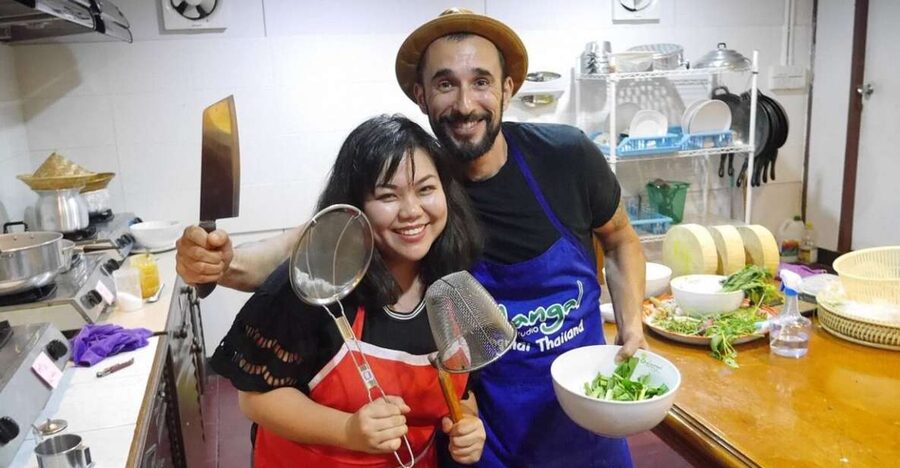
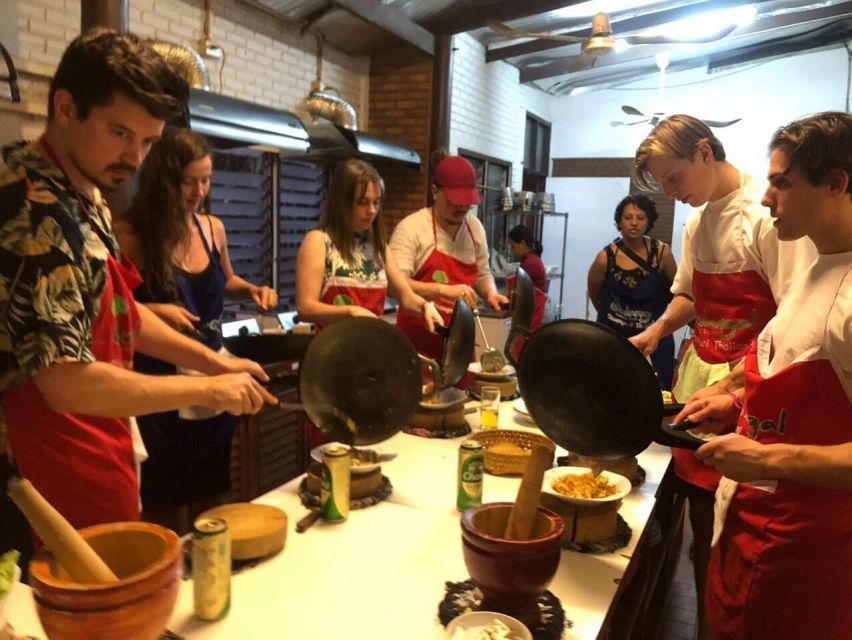
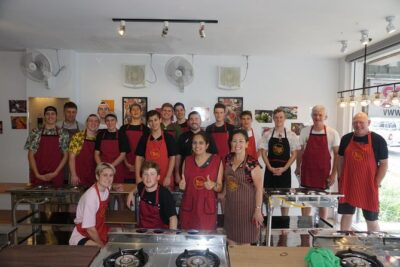
You will not simply watch a chef work. You prepare the food yourself, with the instructor guiding you through each stage. The cooking is accessible to beginners, and the dishes are explained step by step rather than treated as a test of your kitchen skills.
That matters because Thai cooking can look complicated from the outside. Several dishes depend on balancing sweet, sour, salty, spicy, herbal, and creamy flavors. A good teacher helps you see which ingredients create those effects and how the parts fit together.
New receives repeated praise for being friendly, patient, organized, and attentive to each person. Aoy is also singled out as a warm and effective teacher, while Oi has helped create a relaxed class atmosphere. One particularly useful feature is the personal attention given to dietary needs and food dislikes.
The instructors have also been willing to customize dishes. If you do not eat seafood, need vegetarian substitutions, or have an allergy, tell the school in advance and repeat the request at the beginning of class. The class can accommodate vegan, vegetarian, Halal, gluten-free, and other allergy-related requirements, but clear communication remains important.
Group size affects the pace. Larger groups of 10 to 12 people may use the full 4 p.m. to 8:30 p.m. window. Smaller groups can finish earlier, and a quiet session may become very personal. One person even received a one-on-one class when no other participants were booked, so the format can be flexible.
Cool dining space and plenty of food
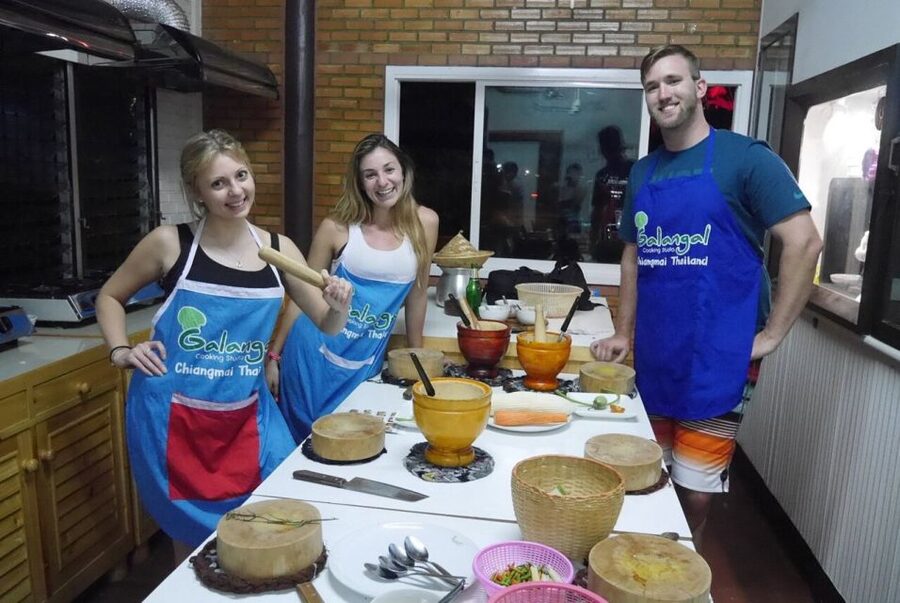
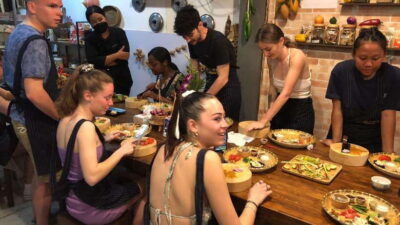
The cooking takes place in an indoor kitchen, followed by a meal in an air-conditioned dining room. That is a welcome detail in Chiang Mai, where chopping, stirring, and eating in a warm open-air setting could become tiring.
After cooking, you sit down and eat what you have made. This shared meal is the payoff, but it is also part of the lesson. You can taste the finished result while the flavors are still fresh and compare the different dishes prepared by the group.
Plan for a large meal. Four dishes per person is a serious dinner, not a token tasting. Several people have found the portions so generous that leftovers were packed to take away. An empty stomach is not just cheerful advice here. It is practical planning.
Water, tea, and coffee are included. Alcohol is not part of the experience, and smoking indoors is not allowed. Bring any personal medication you may need, since that is the only specific item listed for participants to carry.
Recipe choices that make the class worth repeating
The included recipe book comes as a PDF, sent by email or provided digitally after the class. This is more useful than a souvenir that sits in a drawer, because Thai cooking becomes much easier to attempt when you have the ingredient list and method in front of you.
The best value comes from choosing dishes you genuinely want to cook at home. If you already know you love Pad Thai, green curry, or Khao Soi, select those rather than choosing only what seems easiest. You will pay closer attention and have a clearer goal when you return to your own kitchen.
The recipes will not turn every ingredient into a local substitute. Some herbs, pastes, and produce may be harder to find outside Thailand. Still, the class gives you a working method, an understanding of flavor balance, and a better idea of which ingredients matter most.
Is $28 a fair price?
At $28 per person, this is strong value for a five-hour experience. The price includes hotel pickup and drop-off, the market visit, the garden stop, all ingredients, equipment, instruction, water, tea, coffee, and the recipe PDF.
The food alone is not the whole calculation. You are also paying for an English-speaking instructor, transport, a guided look at local produce, and a full meal that you helped prepare. Comparable cooking sessions can cost more without including transfers or a choice of four dishes.
There are two extra-cost details to watch. An adult who observes without cooking pays 500 THB, while an observing child aged 6 to 12 pays 350 THB. If everyone in your party wants to eat and cook, the regular per-person price is the clearer deal.
The class suits couples, families with older children, solo visitors, and small groups of friends. Children and teenagers have enjoyed the format, but the five-hour length and several cooking stages may be a lot for very young children. Infant seats are available for pickup.
The school is near public transportation and is wheelchair and stroller accessible. One listing note says the activity is not suitable for people with altitude sickness, though altitude is not normally a central concern in Chiang Mai. If that warning applies to you, ask the provider before booking.
What the evening does best
The strongest part of this experience is the teaching. New, Aoy, and the other instructors are praised for remembering names, keeping the class on track, explaining ingredients, and creating a friendly mood without making the lesson feel rushed.
The second strength is choice. You are not locked into a single menu that may include food you cannot eat. You can select from several stir-fries, soups, appetizers, and curries, then adjust the dishes around dietary needs.
The third is the balance between local context and practical cooking. The market and garden are brief, but they give meaning to the ingredients. The kitchen session then lets you work with those ingredients rather than simply photograph them.
The main weakness is the pickup window and traffic. You may spend a while collecting people from different hotels, and the driver can be delayed. The class may also end earlier with a small group, so do not assume that the stated 8:30 p.m. finish is fixed.
Should you book this Chiang Mai cooking class?
I would book it if you want a friendly, practical introduction to Thai food and plan to eat dinner during the lesson. The four-dish format, broad menu, dietary flexibility, market stop, recipe PDF, and included transport make $28 a sensible buy.
Choose Khao Soi if you want a Chiang Mai specialty, or pick familiar favorites if your goal is to recreate them at home. Give yourself a loose evening schedule, wait in the lobby early, and tell the school about allergies or dietary restrictions before pickup.
Skip it if you want a long market tour, a quiet private lesson guaranteed in advance, or a short activity with little food. For most people who want to cook, eat, and learn where Thai flavors begin, Galangal Cooking Studio offers a generous evening at a very reasonable price.
FAQ
How long does the Chiang Mai cooking class last?
The experience is scheduled for five hours. Larger groups of 10 to 12 people may run from about 4 p.m. to 8:30 p.m., while smaller groups may finish earlier.
What dishes can I choose to cook?
You can select one dish from each category: stir-fried food, soup, appetizer, and curry or curry paste. Choices include Pad Thai, Pad See Ew, Tom Yum Kung, Tom Kha Kai, Som Tam, spring rolls, green curry, Panang curry, red curry, and Khao Soi.
Is hotel pickup included?
Yes. Pickup and drop-off are included for many hotels in the Old City, Santitham, Huay Keaw Road, and selected nearby areas. Exact coverage depends on your accommodation address.
Can people with dietary restrictions join?
Yes. The class is available for vegan, vegetarian, Halal, gluten-free, and allergy-related dietary needs. You should provide clear details about your requirements before the class.
Is the cooking school wheelchair and stroller accessible?
Yes. The activity is wheelchair and stroller accessible, and infant seats are available for the pickup service.
What happens if I only want to watch?
Adults who observe without cooking pay 500 THB per person. Observing children aged 6 to 12 pay 350 THB per child.
More Workshops
- Thai and Akha Cooking Class in Chiang Mai
★ 5.0 · 4,358 reviews - Chiang Mai: Cooking Class with Organic Farm at Mama Noi
★ 4.9 · 1,151 reviews - Cooking Class with Organic Farm in Chiang Mai at Mama Noi
★ 5.0 · 502 reviews - Chiang Mai: Elephant Sanctuary & Thai Cooking Workshop
★ 4.9 · 276 reviews
More Shopping Tours
- Chiang Mai: Elephants, Sticky Waterfalls, Market and Temple
★ 4.9 · 227 reviews - Cooking Morning Class Chiang Mai Visit Organic Garden and Market
★ 5.0 · 211 reviews - Chiang Mai Temples and Market Tuk-Tuk Evening Night Tour
★ 4.5 · 201 reviews - Cooking Evening Class Chiang Mai Visit Organic Garden and Market
★ 5.0 · 187 reviews
Just added around Chiang Mai
- Chiang Mai: Chiang Rai White, Blue & Black Temples Day Tour★ 4.2 · 16 reviews
- Chiang Mai Adventure ATV Secret Waterfall and Bamboo Rafting★ 5.0 · 16 reviews
- Inthanon Small-Group with Kew Mae Pan Trail from Chiang Mai include Lunch★ 4.5 · 16 reviews
- 2-Day Best of Chiang Rai from Chiang Mai Private Package★ 4.5 · 16 reviews
- Private-Tour Doi Suthep Temple and Khun Chang Kien Village Half-Day★ 4.5 · 16 reviews
- Doi Inthanon Discovery Tour: Waterfalls, Villages & Highest Peak★ 3.5 · 16 reviews
- Chiang Mai Iconic Temples and City Tour★ 4.5 · 17 reviews
- Fantastic! Famous Doi Inthanon National park tour with 2hr trekking★ 4.5 · 17 reviews
Cooking Classes, compared.
Half-Day Thai Cooking Class at Organic Farm in Chiang Mai
Read our review →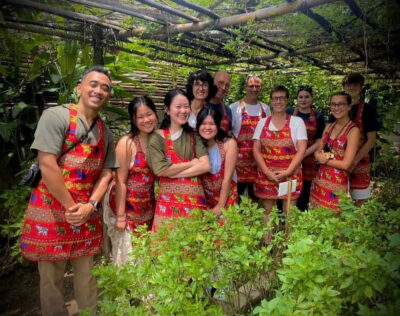
Cooking Class, Market & Thai Herbs Garden Tour
Read our review →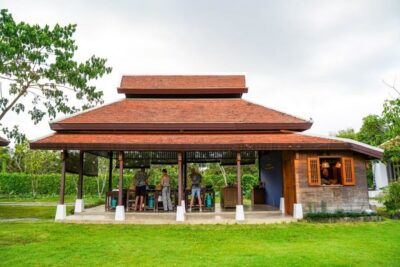
Authentic Cooking Class with Market & Farm Visit
Read our review →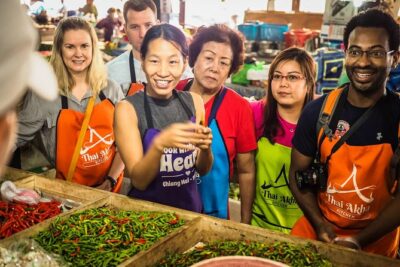
Phuket Thai Cooking Class with Market Tour Option
Read our review →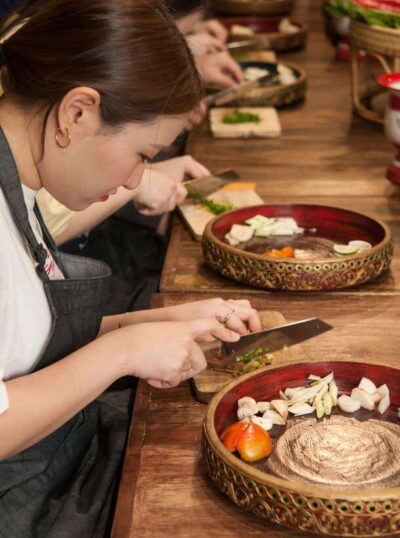
Tingly Thai Cooking School Half-Day Cooking Class
Read our review →Browse the lists this tour appears in