
Reviewed · COOKING CLASSES
Bangkok: Mango Cooking School Thai Cooking Class
Thai cooking starts at the market. Mango Cooking School makes that idea practical, taking you just minutes from BTS On Nut to a local market where an English-speaking chef introduces the herbs, spices, and produce used in class. I like the easy location and the fact that the market visit is offered with both morning and afternoon sessions. The main drawback is that the menu can change, and the class may feel a little simple for highly experienced cooks.
The class then moves into a spotless, air-conditioned kitchen, where you prepare several Thai dishes with guidance at every stage. I especially like the chance to adjust spice levels and the thoughtful setup for families, including child-friendly tools. The food is mainly shellfish-based in places, so check that the menu suits your diet before booking.
In This Review
- Key points at a glance
- A Bangkok cooking class with a useful location
- The market walk: herbs, spices, and a better sense of Thai food
- Inside the clean, air-conditioned cooking studio
- Som tam brings fresh, sharp flavors first
- Pad Thai teaches the familiar Thai classic
- Tom Yum Goong brings the biggest flavor lesson
- Morning glory keeps the meal simple and useful
- Coconut milk and mango sticky rice finish the lesson
- The chefs make the class work for mixed skill levels
- What the $27 price really includes
- Who will enjoy Mango Cooking School most
- Final verdict: should you book it?
- FAQ
- Where is Mango Cooking School located?
- How long does the cooking class last?
- Is the local market tour available in the afternoon?
- What language is the class taught in?
- Which dishes are included?
- Is food included in the price?
- Are recipe materials included?
- Can children attend the class?
- Can parents watch without booking?
- Can I cancel for a full refund?
Key points at a glance
- Two-minute market access: The school sits across from BIG-C On Nut Market, with a five to ten-minute walk from BTS On Nut Station.
- Six Thai preparations: You may make som tam, pad Thai, tom yum goong, stir-fried morning glory, mango sticky rice, and coconut milk.
- A hands-on three-hour class: You chop, mix, stir, cook, taste, and eat as the class moves along.
- Strong English instruction: Chefs such as Serene, PUI, and MC have been praised for clear explanations, patience, humor, and good energy.
- Family-ready facilities: Air conditioning, air purifiers, clean equipment, and child-friendly cooking tools make the room comfortable.
- Useful take-home extras: You receive QR recipe videos, cooking equipment during the class, ingredients, and a small gift.
A Bangkok cooking class with a useful location
Mango Cooking School is in On Nut, an area that is easy to reach by Bangkok’s BTS Skytrain. From On Nut Station, allow about five to ten minutes on foot. The school is across from BIG-C On Nut Market, and the local market used for the class is about two minutes away.
That location matters. You do not need to spend half a day crossing Bangkok for a cooking lesson. You can leave a hotel near the BTS line, reach the school without arranging a taxi, and still have time afterward for shopping or another part of the city.
The surrounding area also gives the class a more useful setting than a cooking studio built only for tourists. You begin near an everyday Thai market, where ingredients are part of normal local life rather than arranged as a display.
The school has a new facility with air conditioning on every floor. Air purifiers are also provided. In Bangkok’s heat, that is not a small detail. Chopping chilies and standing over a hot pan is much easier when the room stays cool.
More Cooking Classes in Bangkok
- Bangkok: Hands-on Thai Cooking Class and Market Tour
★ 4.9 · 1,614 reviews - Bangkok: Tingly Thai Cooking School Half-Day Cooking Class
★ 4.9 · 1,191 reviews - Bangkok: Maliwan Thai Cooking Class with Market Tour
★ 4.9 · 1,133 reviews
The market walk: herbs, spices, and a better sense of Thai food
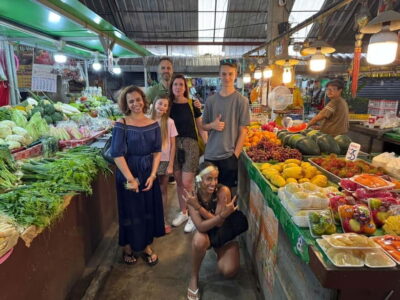
The market portion is available with both morning and afternoon classes. Your instructor leads the short walk and points out the fresh herbs, seasonings, spices, and other ingredients used in Thai cooking.
This is one of the most valuable parts of the three-hour schedule. Thai recipes often list ingredients that are familiar by name but hard to identify in a market. Seeing them before you cook gives you a better chance of finding them later at home.
You may also taste a traditional Thai dessert selected by the Mango chef. That adds a small food discovery before the main lesson begins.
The market visit is short, so you should not expect a full food tour or a long history lesson about Bangkok markets. Its purpose is clear: connect the dishes on your cooking bench with the ingredients sold nearby.
I would bring a camera and comfortable shoes. The walk is brief, but Bangkok sidewalks and market floors are not designed for dress shoes.
Inside the clean, air-conditioned cooking studio
The cooking school has put real thought into the room. Equipment is prepared in advance, ingredients are supplied, and the cooking stations are organized so you can focus on the work rather than hunt for a missing knife or bowl.
The facility has earned repeated praise for being extremely clean and well arranged. That is especially helpful in a class where several people are chopping, stirring, and moving between cooking and eating areas.
The lesson combines chef demonstrations with hands-on work. You do not simply watch a professional prepare food while taking notes. You chop ingredients, mix sauces, stir pans, taste the results, and make adjustments under instruction.
Children aged five to eleven must attend with a guardian, and the guardian must reserve a place as well. If two children aged five or older are booked, only one adult needs to reserve a place. Children cannot attend alone, and parents cannot wait on the side or assist without registering.
That rule is worth understanding before you book. The class is family-friendly, but it is not set up as a drop-off activity or a spectator program. Children under five are not permitted.
Som tam brings fresh, sharp flavors first
Som tam, or green papaya salad, is the appetizer. It is fresh, tangy, and built around the balance that makes Thai food so appealing: sour, salty, sweet, and spicy notes working together.
You learn how the ingredients combine rather than simply receiving a finished plate. That gives you a useful lesson in Thai flavor control. If you do not enjoy much heat, you can usually reduce the chili level during preparation. This ability to control spice is one reason the class works well for first-time cooks.
Som tam also gives you a quick introduction to texture. The salad is crisp and fresh, unlike the soft noodles and soup that follow. Eating each dish soon after making it helps you notice how the ingredients change when freshly prepared.
Something different for another day:
- Bangkok: Damnoen Saduak Market and Maeklong Railway Market
★ 4.5 · 26,723 reviews - The Old Siam: Damnoen Saduak and Maeklong Railway Market
★ 4.5 · 10,992 reviews - From Bangkok: Ayutthaya Temples Guided Tour with Lunch
★ 4.7 · 10,535 reviews - Bangkok: Train Market & Floating Market with Boat Ride
★ 4.7 · 9,547 reviews
Pad Thai teaches the familiar Thai classic
Pad Thai is the dish most people will recognize. It is a sweet and savory stir-fry made with noodles, and it is a good choice for a practical cooking lesson because the method is clear and repeatable.
The chef demonstrates the process, then guides you through your own preparation. You learn how the sauce, noodles, and other ingredients come together in the pan. The class is not only about copying a recipe. It also shows how to adjust the final taste.
This is a dish you can reasonably try at home after the class, especially because QR recipe videos are included. The videos make the gift more useful than a recipe card that disappears into your luggage.
One point to keep in mind is that the recipes are designed to be manageable for a mixed group. If you already cook Thai food often, you may find the Pad Thai section more introductory than technical.
Tom Yum Goong brings the biggest flavor lesson
Tom Yum Goong is the hot and sour shrimp soup. For many people, this is the dish that best shows how Thai cooks build flavor with strong contrasts.
The class lets you work with the ingredients and control the level of chili. That is useful if your tolerance differs from the rest of your group. You can learn the basic structure of the soup without being forced into a heat level you cannot enjoy.
Several participants have singled out the Tom Yum as a favorite dish, and that makes sense. The soup has an immediate payoff: clear, bright flavors and a satisfying aroma as it cooks.
The main dietary caution is the protein. The class menu is primarily shellfish-based in some dishes, including shrimp in Tom Yum Goong. If you have an allergy or avoid seafood, ask about possible adjustments before reserving. The available details confirm that spice levels can be accommodated, but they do not promise every dietary substitution.
Morning glory keeps the meal simple and useful
Stir-fried morning glory is made with garlic and chili. Compared with Tom Yum and som tam, it is a simpler dish, but it teaches a useful everyday Thai technique.
You learn how a few ingredients can produce a flavorful side dish when cooked quickly. This is also one of the more practical recipes to recreate at home, provided you can find morning glory or a suitable local substitute.
The class does not treat every recipe as a long cooking project. Some dishes are quick, and that keeps the three-hour schedule moving. You prepare a dish, eat it, and continue to the next part rather than waiting until the very end for one large meal.
That pacing is a real strength. It gives you several small rewards throughout the class, and it lets the staff clean the cooking area while you eat in a separate room.
Coconut milk and mango sticky rice finish the lesson
The dessert is mango sticky rice, a Thai favorite made with sweet mango, glutinous rice, and coconut sauce. The class also includes the preparation of coconut cream and coconut milk used for the dessert.
This is more than a final sweet course. Making the coconut milk helps you understand why the sauce tastes different from a canned or premixed version. The dessert combines soft, chewy rice with smooth coconut sauce and fresh mango.
You may also taste a traditional Thai dessert selected by the school’s chef. The extra tasting gives you one more small look at Thai sweets without adding a second full recipe to an already busy class.
The menu information describes the class as including five courses while also presenting six food preparations. The practical takeaway is that you should expect several dishes and dessert, but not assume every class will follow an identical count. The school notes that the menu can change based on availability.
The chefs make the class work for mixed skill levels
The instructor is listed as English-speaking, and the strongest part of the teaching is the close guidance. Chefs named in the available feedback include Serene, PUI, and MC. Serene is especially praised for her energy, clear English, patience, and ability to keep everyone involved.
That matters because cooking classes often fail when the teacher moves too quickly. Here, the chef checks what you are doing, explains each step, and offers tips as you work. You get demonstrations, but you also get time to handle the ingredients yourself.
The teaching suits beginners. You do not need to arrive knowing Thai cooking terms or advanced knife skills. At the same time, someone with more experience can still enjoy learning how the chef balances sweet, sour, salty, and spicy flavors.
The class appears especially comfortable for families. Children can use kid-friendly cooking tools, and families with children from seven to thirteen have found the format manageable. Still, parents must book properly and cannot stand beside the class as unregistered helpers.
What the $27 price really includes
At $27 per person, the value is strong for a three-hour Bangkok activity. You receive the market visit, instruction, ingredients, use of cooking equipment, several dishes to eat, QR recipe videos, and a small gift.
The meal itself is not the only value. You also get a practical introduction to ingredients that can be confusing if you encounter them alone in a market. The recipe videos give you a way to repeat the dishes later, which makes the class more than a meal with a demonstration attached.
The five-course meal wording should be read alongside the menu details. You are preparing multiple dishes, including an appetizer, three savory main preparations, dessert, and coconut milk work. The exact menu may change, so I would book this for the activity and the overall meal rather than for one dish alone.
Hotel pickup and drop-off are not included. That is not a major problem because the BTS makes the meeting point straightforward, but you should budget your own train fare or taxi cost.
You can reserve now and pay later, and cancellation is free up to 24 hours before the start time for a full refund. Those terms help if your Bangkok plans are still shifting.
Who will enjoy Mango Cooking School most
I would recommend this class to first-time visitors who want a hands-on taste of Thai food without committing a full day. The BTS location makes it easy to fit into a larger Bangkok schedule.
It is also a strong pick for families with children aged five and older. The air conditioning, clean rooms, child-friendly tools, and patient instruction remove some of the usual stress of cooking with younger participants.
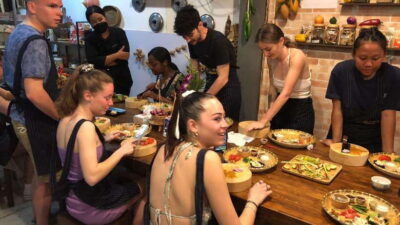
Couples, friends, and solo visitors can also fit in well. The class has a social side, and the shared cooking setup gives you an easy way to meet people without needing to force conversation.
Experienced Thai cooks should set expectations carefully. You will still get fresh ingredients and a chance to adjust flavors, but the recipes are structured so beginners can follow them. The class is about accessible instruction, not advanced restaurant technique.
People with seafood allergies should ask questions before booking. Shrimp and other shellfish are central to parts of the listed menu, and the available information does not guarantee full ingredient replacement.
Final verdict: should you book it?
I would book Mango Cooking School if you want a reasonably priced, well-organized Thai cooking class with a short local market visit. The best features are the convenient BTS access, clean air-conditioned rooms, hands-on format, clear English instruction, and the chance to eat each dish soon after making it.
Choose a different activity if you want a long market tour, advanced culinary training, or a guaranteed fixed menu. For most visitors, though, the $27 price buys a useful slice of Bangkok food culture, several dishes, recipe videos, and a full stomach. Bring comfortable shoes, arrive ready to chop, and check the seafood and menu details before you commit.
FAQ
Where is Mango Cooking School located?
It is across from BIG-C On Nut Market in Bangkok. The school is about a five to ten-minute walk from BTS On Nut Station, and the local market used for the class is about two minutes from the school.
How long does the cooking class last?
The class lasts three hours. Starting times vary, so you should check availability when booking.
Is the local market tour available in the afternoon?
Yes. The market tour is available with both morning and afternoon classes.
What language is the class taught in?
The class is taught in English.
Which dishes are included?
The listed menu includes som tam, Pad Thai, Tom Yum Goong, stir-fried morning glory, mango sticky rice, and preparation of coconut cream and coconut milk. The menu may change depending on the school’s availability.
Is food included in the price?
Yes. A five-course meal is included, along with the ingredients and cooking equipment used during the class.
Are recipe materials included?
Yes. You receive QR recipe videos, which you can use to help prepare the dishes at home.
Can children attend the class?
Children aged five and older can attend. Children aged five to eleven must be accompanied by a guardian, and the guardian must also reserve a place. Children under five are not permitted.
Can parents watch without booking?
No. Unregistered people cannot observe or wait during the class, and parents cannot attend as spectators or assist without making a reservation.
Can I cancel for a full refund?
Yes. You can cancel up to 24 hours in advance for a full refund. You can also reserve now and pay later.
More Workshops
- Hands on Thai Cooking Class and Market Tour
★ 5.0 · 660 reviews - Tingly Thai Cooking Class with Morning Market Tour
★ 5.0 · 589 reviews - Hands-on Thai Cooking Class & Market Tour in Sukhumvit
★ 5.0 · 571 reviews - Pink Chili – Thai Cooking Class and Market Tour in Bangkok
★ 5.0 · 416 reviews
Just added around Bangkok
- Kanchanaburi World War 2 Private Charter Pathway of the Past Tour★ 4.5 · 16 reviews
- 2-hour Bangkok Old City Night CHOB TUK TUK + Talat Noi Street Art★ 5.0 · 16 reviews
- Khao Yai National Park Hiking Day Tour: Haew Narok and Haew Suwat★ 5.0 · 16 reviews
- Floating Market with Great Pagoda Temple and Wat Sam Phran★ 5.0 · 16 reviews
- Shangri-La Hotel’s Salathip Thai Restaurant Experience★ 4.5 · 16 reviews
- Private Transfer Bangkok – Koh Kood Island★ 4.0 · 16 reviews
- Private Half-Day Bangkok Tour Explore Grand Palace and Wat Pho★ 4.5 · 16 reviews
- The Best Bangkok Temples★ 4.0 · 16 reviews
Cooking Classes, compared.
Half-Day Thai Cooking Class at Organic Farm in Chiang Mai
Read our review →
Cooking Class, Market & Thai Herbs Garden Tour
Read our review →
Authentic Cooking Class with Market & Farm Visit
Read our review →
Phuket Thai Cooking Class with Market Tour Option
Read our review →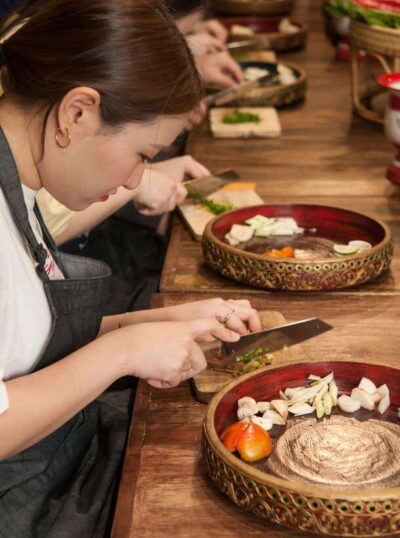
Tingly Thai Cooking School Half-Day Cooking Class
Read our review →Browse the lists this tour appears in