
Reviewed · COOKING CLASSES
Morning Thai cooking class
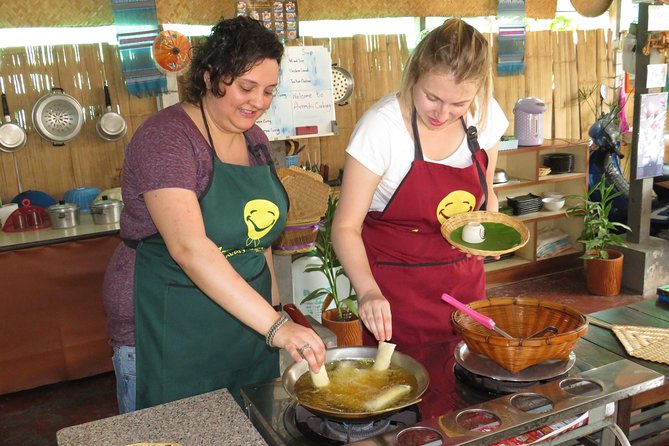
Come hungry, leave with dinner ideas. This Chiang Mai cooking class combines a short local market visit with hands-on preparation of five Thai dishes, making it a practical way to taste the city. I especially like the small group of no more than eight and the broad menu, which lets you choose dishes that suit your taste, including vegan and vegetarian options. The main drawback is simple but important: the kitchen and dining room have fans, not air-conditioning, so the class may feel hot from March through June.
You start at 9 a.m. at Kad Kom Market and finish back at the meeting point after about four and a half hours. I also like that nearby pickup is included for locations within 3 kilometers, though you should not expect door-to-door transport from every part of Chiang Mai. At $27.70 per person, the price is fair for a market tour, five dishes, drinks, fruit, instruction, and recipes.
In This Review
- Key points to know before booking
- Starting at Kad Kom Market at 9 a.m.
- Choosing five dishes from a generous menu
- Cooking from stir-fry to soup
- Making curry paste from scratch
- Dessert, fruit, and a meal you helped make
- The heat is part of the decision
- Small group size and the pace of the morning
- Pickup, meeting point, and planning your morning
- Who will get the most from this class?
- Is the $27.70 price good value?
- Should you book the Aromdii morning class?
- FAQ
- Where does the Thai cooking class start?
- What time does the experience begin?
- How long does the activity last?
- How many people can join the class?
- Is hotel pickup included?
- How many dishes do you cook?
- Can you choose your own dishes?
- Is the cooking school air-conditioned?
Key points to know before booking
- You choose five dishes before cooking begins: Select one stir-fry, appetizer, soup, curry, and dessert from a useful menu.
- The market visit lasts about 15 to 20 minutes: You help collect ingredients and learn about Thai vegetables, herbs, and spices.
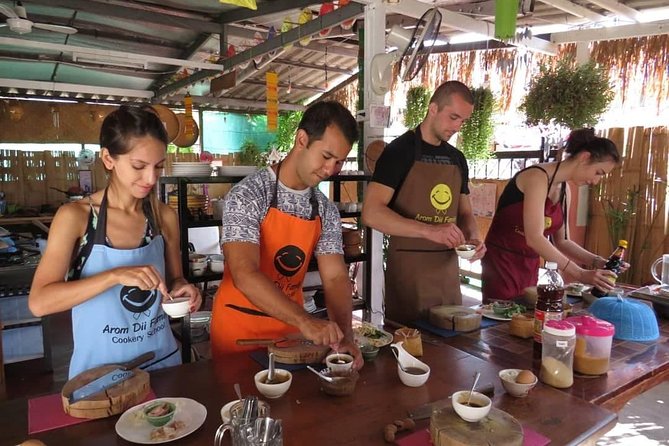
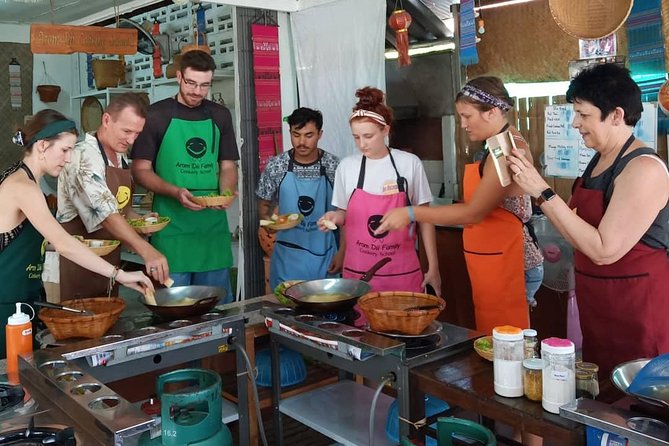
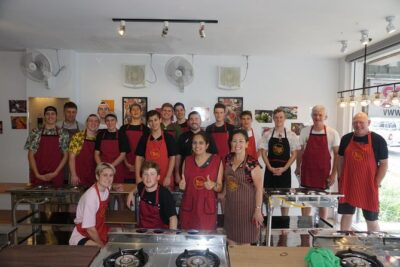
- The group is capped at eight people: That is small enough for personal help and a calmer cooking session.
- Khao soi is one of the curry choices: This Chiang Mai noodle dish gives the class a strong local connection.
- The kitchen is fan-cooled only: Plan for heat, especially during the March to June summer period.
- Pickup is limited to nearby locations: Transport is included only when your starting point is within 3 kilometers.
Starting at Kad Kom Market at 9 a.m.
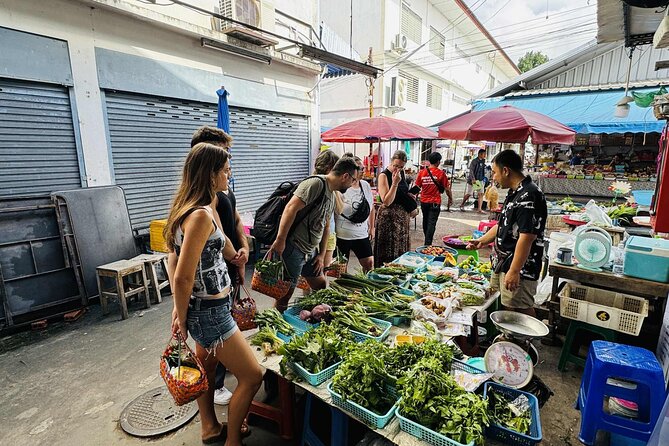
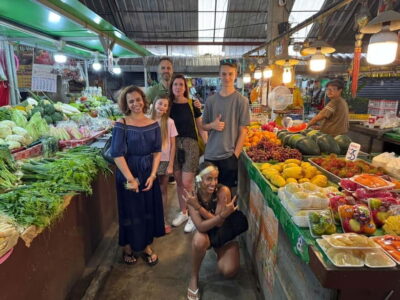
The morning begins at Kad Kom Market, listed as the meeting point at 19, Moo 3, Wiang Thong 1, in Chang Khlan. Arriving here puts the food lesson in the right setting. Instead of beginning with a pile of premeasured ingredients, you first see where some of the cooking starts.
The market portion takes about 15 to 20 minutes. That is not long enough for a full market tour, and it should not be treated as one. Think of it as a focused shopping stop before class. You choose your dishes, then help gather the produce needed for those selections.
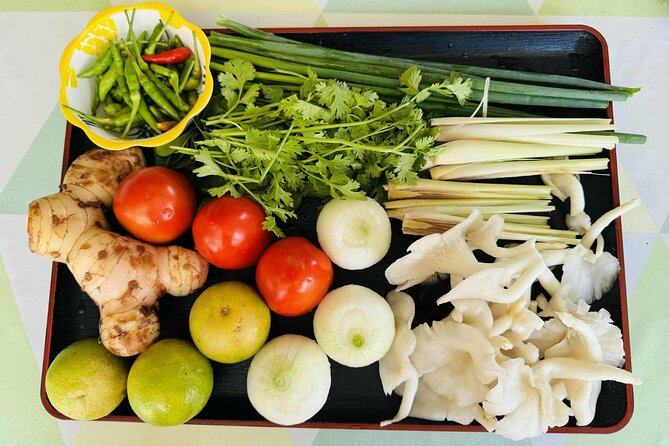
This short visit is useful because Thai cooking depends on fresh herbs, vegetables, curry ingredients, and contrasting flavors. You are shown Thai vegetables, spices, and herbs, with time to walk around, take photos, or buy spices to take home. The shopping element also helps explain why the menu is organized by course rather than by a fixed set meal.
The order matters. You make your choices before the class starts, so you know what you will cook and what to look for at the market. If you want a particular dish, decide early. Choices include familiar favorites such as pad Thai and green curry, along with dishes that feel more tied to northern Thailand, such as khao soi.
More Cooking Classes in Chiang Mai
- Half-Day Thai Cooking Class at Organic Farm in Chiang Mai
★ 5.0 · 19,087 reviews - Chiang Mai: Cooking Class, Market & Thai Herbs Garden Tour
★ 4.9 · 4,824 reviews - Chiang Mai: Authentic Cooking Class with Market & Farm Visit
★ 4.9 · 4,546 reviews
Choosing five dishes from a generous menu
The class lets you choose one dish from each of five categories. This is a good design for mixed groups because one person can choose a classic dish while another picks something vegetarian or more adventurous.
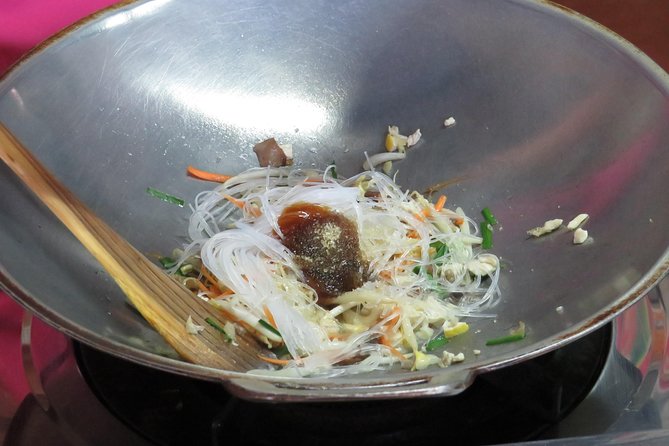
For the stir-fried course, you can choose pad Thai, fried drunken noodles, pad see ew, or fried cashew nut. These dishes offer different lessons in texture and seasoning. Pad Thai is the obvious first choice for many people, while pad see ew gives you a darker, more savory noodle dish. Fried drunken noodles bring a stronger flavor profile, and fried cashew nut works well if you prefer a dish centered on vegetables and nuts.
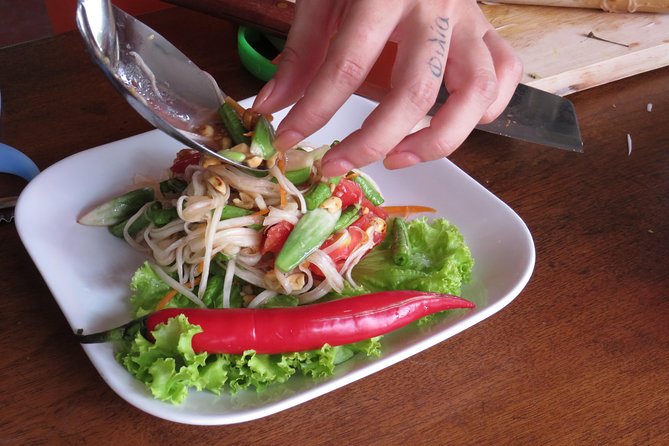
The appetizer choices are papaya salad, fresh spring rolls, fried spring rolls, or mixed fruit salad. This is also where dietary needs can be easier to manage. Fresh spring rolls and fruit salad provide lighter options, while papaya salad introduces the sharp, fresh balance that appears in many Thai meals.
For soup, you can choose hot and sour prawns thick soup, coconut chicken, tom yum chicken, or hot and sour prawns clear soup. The two hot and sour prawn options are especially useful for comparing a thicker soup with a clear version. If you do not eat seafood, the chicken options give you a straightforward alternative.
The curry category includes khao soi, green curry, Massaman curry, and red curry. Khao soi, described here as Chiang Mai noodles, is the most locally specific option. It gives the morning a clear Chiang Mai identity rather than making the class feel like a generic Thai cooking lesson.
Dessert choices are mango sticky rice or pumpkin in coconut milk. Both are traditional, uncomplicated endings to a filling meal. Mango sticky rice is the familiar favorite, while pumpkin in coconut milk offers something less expected and shows how coconut milk appears in sweet dishes as well as savory ones.
You make five dishes in total, one from every category. That is a substantial amount of cooking for a four-and-a-half-hour morning, especially at this price. It also means you should not assume you will master every item on the full menu. You learn the dishes you select.
Cooking from stir-fry to soup
At the cooking school, the class begins with the stir-fried dish. This is a sensible opening because it gets you working quickly and introduces the basic rhythm of Thai cooking. You are not spending the first hour watching a long demonstration. Instead, the menu choices lead directly into preparation.
The small group matters here. With a maximum of eight people, the instructor has a better chance of seeing what you are doing and offering personal comments. A larger class could still be fun, but it would be harder to ask about a sauce, a texture, or a substitution while everyone is working.
After the stir-fry, you prepare soup and the appetizer. These two courses give the class a different pace. Stir-frying is about quick cooking, while soup and salad bring more attention to balance. Thai dishes often depend on the relationship between sour, salty, sweet, spicy, creamy, and fresh flavors. The menu gives you several ways to explore that balance without forcing everyone into the same meal.
The listed class sequence is stir-fry first, followed by soup and appetizer, then dessert and curry. You should expect the day to move between preparation, cooking, and eating rather than follow a restaurant-style five-course service. The point is to learn by doing, with your chosen dishes forming the meal.
Making curry paste from scratch
The curry course is likely the most hands-on part of the morning. You make the curry paste from scratch, then use it for your selected curry. That step gives you more than a finished bowl of sauce. It shows how a curry gets its character from its base ingredients.
You can choose khao soi, green curry, Massaman curry, or red curry. These are not identical lessons. A green or red curry gives you a familiar Thai curry format, while Massaman offers a different flavor direction. Khao soi connects the cooking session to Chiang Mai and is a smart choice if you want the class to reflect where you are.
The curry section also explains why the market stop is worth keeping, even though it is brief. Fresh herbs and spices are not just decoration. They form the foundation of the paste, and seeing them before class gives you a clearer link between raw ingredients and the food on your plate.
If you are trying to pack light, the market stop still gives you a chance to buy spices for home. The information provided does not specify how much shopping time you will have, so treat this as an optional extra rather than the main purpose of the morning.
Something different for another day:
- Chiang Mai: Elephant Sanctuary, Waterfall & Bamboo Rafting
★ 4.9 · 9,160 reviews - Chiang Mai: Doi Inthanon National Park Eco-Friendly Tour
★ 4.6 · 6,667 reviews - Chiang Mai: Elephant Sanctuary & Waterfall Group Tour
★ 4.9 · 5,780 reviews - Chiang Mai: Chiang Rai Temples, Karen Tribe and Hot Springs
★ 4.7 · 5,401 reviews
Dessert, fruit, and a meal you helped make
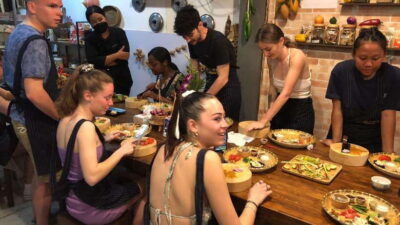
The class ends with dessert and curry, and the included food extends beyond your five chosen dishes. Bottled water and seasonal fruit are included, which is welcome in Chiang Mai’s warm climate. The fruit also gives you a lighter break during a morning that includes several cooked dishes.
Mango sticky rice is the more recognizable dessert choice. Pumpkin in coconut milk is a good pick if you want to try something different from the standard Thai dessert found on many menus. Both choices keep the final course connected to local cooking rather than adding a Western-style finish.
The meal is part of the value. At $27.70, you are not paying only for a demonstration or a market walk. You are choosing ingredients, preparing five dishes, eating the results, and receiving access to handmade recipes through the school’s website. For someone who wants a useful activity rather than a passive sightseeing stop, that package makes sense.
Still, keep expectations realistic. This is one morning, not professional culinary training. You will leave with recipes and practical experience, but your results may depend on how much individual instruction you need and which dishes you choose.
The heat is part of the decision
The cooking and eating spaces do not have air-conditioning. They use fans only. That is the clearest comfort issue, and it should influence your booking decision more than the low price does.
Chiang Mai’s seasons are listed as summer from March through June, rainy season from July through October, and winter from November through February. The fan-only setup may be easier to handle in the cooler months. From March through June, standing near a stove while preparing several dishes could feel tiring.
The rainy season brings a different concern because the activity requires good weather. If poor weather causes cancellation, you are offered another date or a full refund. The same applies if the minimum number of participants is not reached.
Wear clothing that can handle heat and cooking smells, and bring a practical attitude. The lack of air-conditioning does not ruin the class, but it does mean this is not a cool, polished studio experience. The setting is more functional than fancy.
Small group size and the pace of the morning
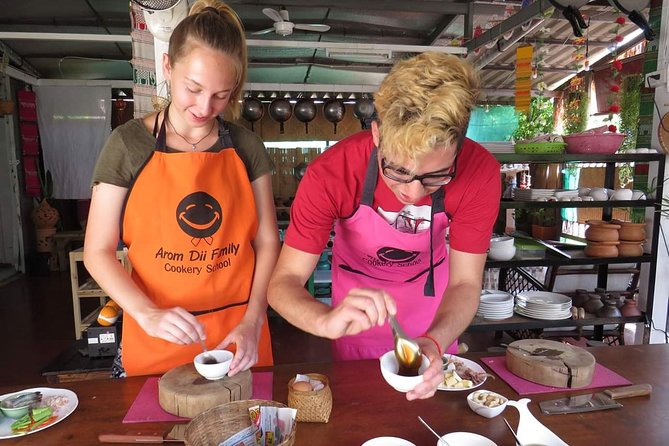
The maximum group size is eight, and that limit is one of the strongest reasons to book this class. A cooking lesson works best when you can see the instructor’s movements, ask questions, and receive help without waiting behind a crowd.
A French-language account of the class praised the organization, friendly atmosphere, and the personal comments possible with eight people. That fits the format well. Eight is large enough for a social morning but small enough to keep the instruction useful.
The 4.5-hour duration also gives the class room to breathe. You are not rushing through one recipe before being sent away. The morning includes the market, five dishes, eating time, and recipe access. The tradeoff is that this takes a sizeable part of your Chiang Mai morning. If you have a packed sightseeing schedule, you will need to plan around the 9 a.m. start and the return to the meeting point.
The activity ends where it begins. That makes it easier to continue your day, but you should allow time after the advertised duration in case the final meal or transport runs slightly over.
Pickup, meeting point, and planning your morning
Pickup is offered for nearby locations within 3 kilometers. This is helpful if you are staying close to the school, but it is not a citywide hotel transfer. If your accommodation is farther away, plan to reach Kad Kom Market yourself.
The meeting point is near public transportation, according to the practical information provided. Since the exact transport route is not specified, check your position in relation to the market before the morning of the class. A mobile ticket and booking confirmation make the entry process simple, but you still need to identify the meeting point clearly.
No visitors are allowed to take part without booking. Space is reserved for participants only. That rule helps keep the group at its stated size and prevents the kitchen from becoming crowded.
Free cancellation is available up to 24 hours before the start time for a full refund. Changes or cancellations made inside that 24-hour window are not accepted for a refund. The cutoff follows local Chiang Mai time, so make the decision before the final day.
Who will get the most from this class?
I would recommend this experience to you if you want to do more than eat Thai food. It suits first-time cooks, couples, solo participants, and small groups who like a social activity with a clear result at the end.
It is also a good fit if you want to choose your own dishes. The menu is broad enough to support different tastes, and vegan and vegetarian options are available. You can pick familiar food, try khao soi, or build a meal around lighter choices.
You may want to skip it if you strongly dislike heat or need an air-conditioned cooking space. The fan-only kitchen is not a hidden detail. It is the main comfort limitation.
I would also think twice if your priority is an extensive market tour. The market portion lasts only 15 to 20 minutes. It is a useful ingredient-shopping introduction, not a long cultural walk with extended time at every stall.
Is the $27.70 price good value?
For $27.70 per person, the class offers a lot of activity in one morning. You get a market stop, instruction, five dishes, bottled water, seasonal fruit, a small group, and recipe access. Nearby transport is included when the pickup location falls within 3 kilometers.
The value is strongest if you will use the recipes after returning home. Cooking five dishes gives you more practical material than a class built around one main course. The curry paste lesson adds another useful skill, especially if Thai food is a regular part of your eating or cooking life.
The value is weaker if you mainly want a comfortable meal or a long guided tour. The class requires participation, and the lack of air-conditioning may make the morning less relaxing. You are paying for hands-on work, not just a plate of food.
Should you book the Aromdii morning class?
Book it if you want a friendly, small-group introduction to Thai cooking with a real market start and plenty of menu choice. The eight-person limit, five-dish format, curry paste lesson, and Chiang Mai-specific khao soi option give it more substance than a quick cooking demonstration.
Choose a cooler season if possible, or at least prepare for a warm kitchen. Confirm that your accommodation is within 3 kilometers if you want pickup, and remember that the market tour is short. With those points in mind, this is a strong-value morning for food lovers who want to take a piece of Chiang Mai’s cooking home with them.
FAQ
Where does the Thai cooking class start?
It starts at Kad Kom Market, at 19, Moo 3, Wiang Thong 1, Tambon Chang Khlan, Chiang Mai 50100, Thailand.
What time does the experience begin?
The class starts at 9 a.m.
How long does the activity last?
The activity lasts approximately 4 hours and 30 minutes.
How many people can join the class?
The class has a maximum of eight participants.
Is hotel pickup included?
Pickup is included for nearby locations within 3 kilometers of the cooking school. Locations farther away are not covered by the included transport.
How many dishes do you cook?
You cook five dishes from five categories: one stir-fried dish, one appetizer, one soup, one curry, and one dessert.
Can you choose your own dishes?
Yes. You choose the menu before the class begins. The options include pad Thai, papaya salad, tom yum chicken, khao soi, green curry, mango sticky rice, and other dishes.
Is the cooking school air-conditioned?
No. The kitchen and dining room have fans but no air-conditioning.
More Workshops
- Thai and Akha Cooking Class in Chiang Mai
★ 5.0 · 4,358 reviews - Chiang Mai: Cooking Class with Market and Pickup
★ 4.9 · 1,365 reviews - Chiang Mai: Cooking Class with Organic Farm at Mama Noi
★ 4.9 · 1,151 reviews - Chiang Mai: Evening Cooking Class and Local Market Visit
★ 4.9 · 648 reviews
Just added around Chiang Mai
- Chiang Mai: Chiang Rai White, Blue & Black Temples Day Tour★ 4.2 · 16 reviews
- Chiang Mai Adventure ATV Secret Waterfall and Bamboo Rafting★ 5.0 · 16 reviews
- Inthanon Small-Group with Kew Mae Pan Trail from Chiang Mai include Lunch★ 4.5 · 16 reviews
- 2-Day Best of Chiang Rai from Chiang Mai Private Package★ 4.5 · 16 reviews
- Private-Tour Doi Suthep Temple and Khun Chang Kien Village Half-Day★ 4.5 · 16 reviews
- Doi Inthanon Discovery Tour: Waterfalls, Villages & Highest Peak★ 3.5 · 16 reviews
- Chiang Mai Iconic Temples and City Tour★ 4.5 · 17 reviews
- Fantastic! Famous Doi Inthanon National park tour with 2hr trekking★ 4.5 · 17 reviews
Cooking Classes, compared.
Half-Day Thai Cooking Class at Organic Farm in Chiang Mai
Read our review →
Cooking Class, Market & Thai Herbs Garden Tour
Read our review →
Authentic Cooking Class with Market & Farm Visit
Read our review →
Phuket Thai Cooking Class with Market Tour Option
Read our review →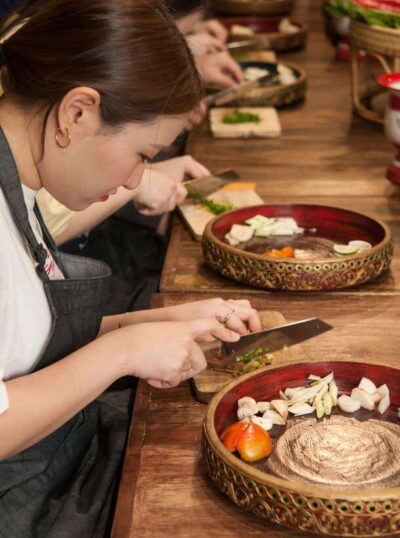
Tingly Thai Cooking School Half-Day Cooking Class
Read our review →Browse the lists this tour appears in